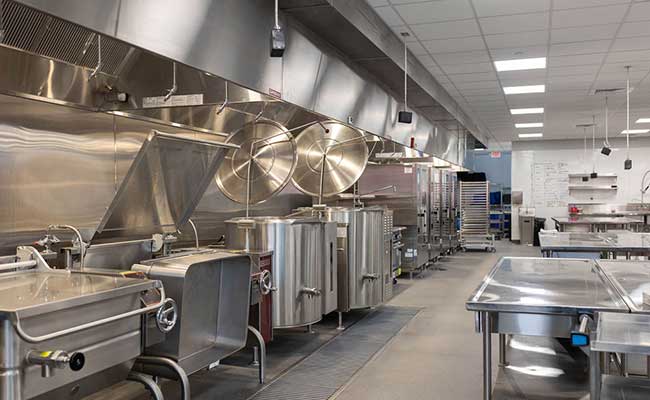
South Rouhina Steel Complex – The presence of steel in the food and beverage industry is not merely a matter of structural integrity; it is essential for maintaining hygienic standards and ensuring product safety. From small food-processing facilities to the busy kitchens of large food manufacturing plants, this industry relies on innovation, quality, and efficiency.
Therefore, Hygienic Design plays a particularly important role in this industry. In simple terms, hygienic design refers to the design and construction of equipment and facilities in a way that reduces or eliminates the risk of contamination during food and beverage processing by facilitating easy cleaning, resisting microbial growth, and preventing the accumulation of harmful bacteria.
This process encompasses every aspect of design and manufacturing, from material selection and surface finishing to component assembly and welding techniques. Its objective is to ensure that every element contributes to food safety and facilitates cleanliness throughout the production process.

Choosing the Right Stainless Steel for the Food Industry
When it comes to food-processing equipment, selecting the appropriate type of stainless steel is of great importance. Two of the most commonly used grades are 304 and 316 stainless steel, each serving different purposes.
Grade 304, often regarded as a standard choice for food-processing applications, offers excellent corrosion resistance and is suitable for a wide range of food-processing environments.
Grade 316, however, contains molybdenum, which provides enhanced protection against acidic foods and aggressive disinfecting chemicals. This makes it particularly valuable in dairy processing and in environments exposed to high levels of chlorides.
Surface Finishes and Their Impact on Hygiene
Surface finish plays a critical role in hygienic design and has a significant impact on cleanability and bacterial adhesion. A surface roughness of 0.8 μm Ra or lower is generally recommended for food-contact surfaces, although specific requirements may vary depending on the application.
Mirror-polished finishes provide excellent hygienic properties but come at a higher cost. Properly applied brushed finishes can offer a practical balance between hygiene and cost-effectiveness.
The key consideration is to ensure a consistent surface finish across all food-contact areas in order to prevent the formation of sites where bacteria can accumulate.
Best Practices for Welding and Fabrication
Proper welding techniques are essential for hygienic design. Instead of spot or stitch welds, continuous welds should be used, as discontinuous welds can create gaps that may become breeding grounds for bacteria.
Ground and polished welds should be smooth and free of crevices to ensure both structural integrity and hygienic performance.
Welding stainless steel for food-industry applications requires particular attention because even a minor welding defect can result in microbial contamination, corrosion, or premature equipment failure.
Common welding problems in the food industry include:
- Surface contamination and reduced corrosion resistance: This can lead to iron contamination and localized corrosion.
- Heat tint: Blue or brown discoloration may appear around the weld and can reduce corrosion resistance.
- Incorrect filler metal or electrode selection: This may result in galvanic corrosion and cracking.
- Intergranular corrosion (IGC): One of the most dangerous forms of localized corrosion, occurring along the grain boundaries of metals. It can significantly reduce the mechanical strength of the material while leaving the surface apparently intact.
- Incomplete penetration or porosity: Porosity consists of small or large voids within the weld structure that can provide suitable sites for bacterial accumulation.
Easy-to-Clean Design
A cornerstone of hygienic design is the creation of equipment that is easy to clean and maintain.
This means incorporating sufficient radii—typically at least 3 mm—in internal corners to prevent material accumulation and facilitate effective cleaning. All surfaces should be self-draining, which is generally achieved through a minimum slope of approximately 3 degrees.
Dead spaces, where food products may accumulate and cleaning solutions cannot effectively reach, should be eliminated through thoughtful design.
These considerations not only improve food safety but can also significantly reduce cleaning time and the amount of cleaning chemicals required.
Standards and Certification
Compliance with regulatory requirements is essential in the production of food and beverages.
Current standards provide comprehensive frameworks for hygienic design, typically covering material certificates, surface-finish measurements, and weld-inspection reports.
Manufacturers must ensure that their fabrication processes comply with these standards at every stage, from initial design through final installation.
Steel and Food Safety
Although steel may often remain behind the scenes in the food industry, its role is fundamental. The right grade of stainless steel, an appropriate surface finish, hygienic welding practices, and compliance with relevant standards all contribute to creating safer, cleaner, and more efficient food-processing environments.
Ultimately, choosing and processing steel correctly is not simply an engineering decision; it is an important part of protecting food quality and ensuring consumer safety.